The bookshelf
Find your next read
Explore our books by author and subject.
Marco Valenti
Series I
FORGOTTEN MEN OF THE ROMAN REPUBLIC
Each volume recovers the life and career of a Roman who helped build the Republic, reconstructed from the ancient sources and presented for the general reader. All titles are published in hardcover.
LIBER I
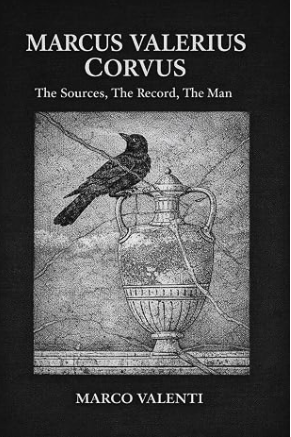
The raven's champion and the Republic's longest career
In 349 BC a young military tribune accepted a Gallic champion's challenge to single combat — and, the Romans said, a raven settled on his helmet and fought beside him. The duel made his name; the career that followed made him one of the most honored men in the Republic's history. Six times consul across nearly half a century, twice dictator, victor over Gauls, Volsci, and Samnites, Marcus Valerius Corvus was celebrated by later Romans as a model of courage, moderation, and longevity. This volume assembles the surviving evidence for his remarkable life and asks what it reveals about Rome in the age when the Republic first became a great Italian power.
View on AmazonExplore the history, sources, and free book sample →
LIBER II
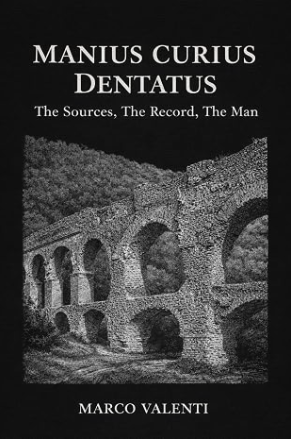
The plebeian farmer who beat the Samnites and Pyrrhus
When Samnite envoys found Manius Curius Dentatus roasting turnips at his hearth and offered him gold, he replied that he would rather rule those who possessed gold than possess it himself. The anecdote became Rome's favorite lesson in incorruptibility — but the man behind it was one of the Republic's greatest soldiers. Dentatus ended the long Samnite Wars, defeated Pyrrhus of Epirus at Beneventum in 275 BC, and as censor began the aqueduct that watered Rome for centuries. This volume recovers the career of the plebeian farmer-general whom later Romans invoked whenever they wanted to remember what the old Republic had been.
View on AmazonExplore the history, sources, and free book sample →
LIBER III
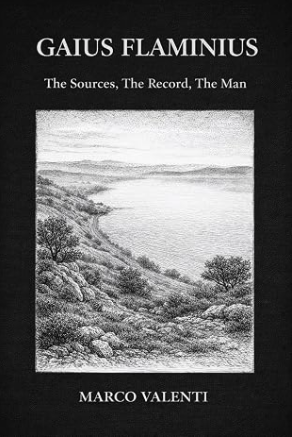
The people's consul who died at Lake Trasimene
A century before the Gracchi, Gaius Flaminius defied the Senate to give public land to Roman citizens — and spent the rest of his career paying for it. Twice consul, censor, and builder of the great northern road and the Circus that carried his name, Flaminius won a major victory over the Gauls of the Po valley and became the champion of the common voter against the nobility. In 217 BC he led his army along the misted shore of Lake Trasimene, into the most devastating ambush in Roman history. This volume examines the reformer the ancient sources blamed for his own destruction, and asks whether the verdict was fair.
View on AmazonExplore the history, sources, and free book sample →
LIBER IV
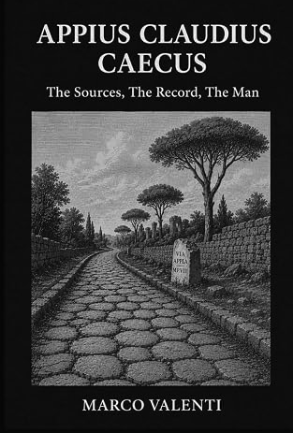
The blind censor who built the Republic's foundations
Rome's first great road and first aqueduct both bear his name. As censor in 312 BC, Appius Claudius Caecus reshaped the Republic — revising the Senate’s membership and the organization of the citizen body, reorganizing state religion, and building the Via Appia and the Aqua Appia. Decades later, old and blind, he was carried into the Senate to deliver the speech that turned Rome against peace with Pyrrhus: the earliest Roman oration whose memory survived to later ages. Statesman, builder, reformer, and the first named figure of Latin prose, Appius Claudius stands at the point where Roman history begins to come into focus. This volume tells his story from the surviving evidence.
View on AmazonExplore the history, sources, and free book sample →
LIBER V
Rome's first victory at sea
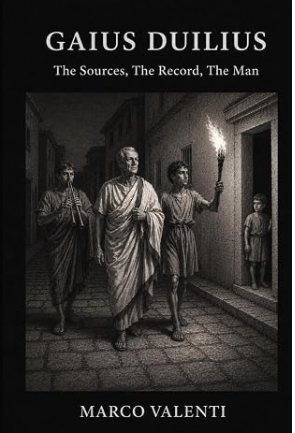
In 260 BC Rome had possessed a war fleet for barely a year, and Carthage had ruled the western Mediterranean for centuries. At Mylae, off the coast of Sicily, the consul Gaius Duilius met the Carthaginian navy with a weapon no one had seen before — the corvus, a boarding bridge that turned sea battles into land battles — and won Rome’s first major fleet victory over Carthage. The Republic gave him its first naval triumph, a commemorative column decorated with the bronze rams of captured ships, and the lifelong honor of a torchbearer and flute player to escort him home each night. This volume recovers the man behind Rome's first triumph at sea.
View on AmazonExplore the history, sources, and free book sample →
Forthcoming in Series I: Gaius Lutatius Catulus, the consul who ended the First Punic War.
· · ·
Series II
FORGOTTEN DOCUMENTS OF THE ROMAN REPUBLIC
The Republic governed itself, and the Mediterranean, through documents — treaties, laws, and inscriptions now lost or surviving only in fragments and quotations. The series explores these documents and the people who made them, pairing close studies of individual agreements with broader surveys of Roman diplomacy.
VOLUMEN I
The peace that ended the First Punic War
In 241 BC, after twenty-three years of war, Rome and Carthage made peace. The agreement that ended the longest continuous war of classical antiquity survives in no official copy — only in the summaries and quotations of ancient historians, above all Polybius. This volume reconstructs the Treaty of Lutatius clause by clause, presenting the attested text alongside what must be restored, with translation, commentary, and the story of the negotiation itself. The treaty gave Rome its first overseas province and set the terms of the uneasy peace that led, a generation later, to Hannibal. Here, for the first time in English, it receives book-length treatment.
View on Amazon
Explore the treaty: terms, sources, and a free book sample →
FORGOTTEN DOCUMENTS OF THE ROMAN REPUBLIC
A Short History of Rome’s Major Agreements
From Rome’s alliances with its Latin neighbors to Sulla’s peace with Mithridates, Marco Valenti follows the agreements that helped turn a city in Italy into a Mediterranean power. This illustrated survey explains what the parties promised, how peace was negotiated, and what happened when those promises were tested. It includes clear readings of the surviving terms, eight symbolic drawings, source notes, a timeline, and a guide to the principal figures.
Explore the bookHow Roman treaties worked: guide and free sample →
Available on Amazon