
Roman treaties could establish friendship, regulate trade, arrange military assistance, or impose the terms of peace. They were shaped by the parties’ power and circumstances, so understanding an agreement requires asking who could approve it, what obligations it created, and how those obligations were later interpreted.
What did a Roman treaty actually do?
A treaty made a relationship more specific. Peace might stop the fighting, while its clauses determined who must withdraw, what prisoners would be returned, how much money would be paid, and which allies would receive protection. An agreement between powers still at peace could instead define where merchants could operate or what assistance one state might expect from the other.
The early agreements between Rome and Carthage illustrate that variety. Polybius preserves provisions concerning navigation, trade, and communities in Latium, alongside restrictions on particular territories. Reading those terms prevents us from treating every agreement as a peace imposed after a battle. Some were attempts to manage contact before it turned into open conflict. [1]

Could a commander make peace on his own?
A commander could negotiate, but the authority of the resulting agreement still mattered. The preliminary settlement made by Lutatius after the naval victory of 241 BC was expressly subject to Roman popular approval. Polybius reports that the initial terms were not accepted unchanged and that commissioners subsequently increased the financial demands and shortened the payment period. [2]
The example shows why a battlefield agreement and a final settlement should not automatically be treated as the same document. A negotiator might secure consent from the enemy while still needing approval at home, where others could judge the bargain differently. The soldiers’ immediate need to end a campaign was only one consideration in that wider decision.
It would be equally misleading to assume that every Roman agreement followed one unchanging procedure across centuries. A better approach is to identify the authority described in each surviving account and to notice where the source leaves the process unclear.
Why did treaties involve religious oaths?
Oaths placed the promise under divine sanction as well as public obligation. In his discussion of the Roman-Carthaginian agreements, Polybius describes a Roman oath invoking Jupiter and a stone: the person swearing called down exclusion upon himself if he broke faith, then cast the stone away. The gesture made the threatened consequence visible. [3]
That ceremony was not a substitute for clauses, ambassadors, or enforcement. It belonged alongside them, expressing the seriousness of a commitment in terms the participants recognized. Polybius also distinguishes the oaths associated with different agreements, so this particular description should not become a universal script for every Roman treaty.
How can we read the terms clearly?
The most useful first step is to turn each clause into a practical question while keeping its qualifications intact. A demand for money needs a total and a schedule; a promise of assistance needs an explanation of who supplies transport and who pays the troops. Without those details, an apparently clear agreement can become much vaguer in a modern summary.
| Provision | What to look for | Example in Polybius |
|---|---|---|
| Territory | Who must leave, and which places are named? | Carthaginian evacuation of Sicily in 241 BC. |
| Payments | How much is due immediately, and how much later? | 1,000 talents at once and 2,200 over ten years in the final Sicilian settlement. |
| Military aid | Who supplies ships, wages, and crews? | The agreement during Pyrrhus’s invasion assigns transport to Carthage but each state pays its own troops. |
| Allies | Who receives protection, and can later allies be included? | The allies clause became disputed in arguments over Saguntum. |
These examples come from Polybius’s account of the agreements and the later arguments about them. The table is a modern reading aid, not the text of a single ancient treaty. [3] [4]
Why could a treaty fail even when its wording survived?
Written terms did not remove disagreement about their meaning. In discussing the approach to the Hannibalic War, Polybius records competing arguments about the protection of allies and the standing of the agreement with Hasdrubal. Parties could agree that an obligation existed while disputing its scope or whether the person who made an agreement had bound the state. [4]
The balance of power could also change. The later demand that Carthage surrender Sardinia and pay an additional indemnity must be distinguished from the original peace of 241 BC. Polybius himself criticizes the Roman action, which reminds us that ancient historians could question the justice of a settlement rather than simply celebrate the stronger party. [5]
Do the original treaty documents survive?
For many of the agreements discussed in Marco Valenti’s book, readers depend on quotations, summaries, and narratives preserved by ancient authors rather than an intact original document. Polybius says that early Roman-Carthaginian treaties were preserved on bronze tablets at Rome, but our access to those particular terms comes through his account. A translation of his report is therefore not the same thing as a photograph or complete transcription of an original tablet. [6]
The Treaties of the Roman Republic follows major agreements from Rome’s Latin relationships to Sulla’s peace with Mithridates. The sample below presents its opening guide to how Rome made an agreement, while the separate Lutatius guide offers a closer examination of one settlement and its consequences.
Read The Treaties of the Roman Republic by Marco Valenti
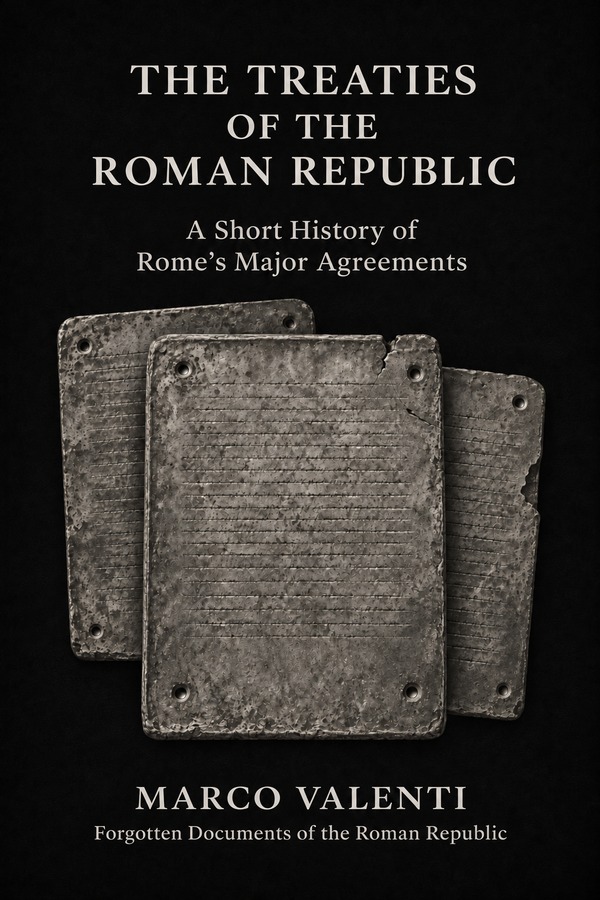
The free 11-page PDF includes the title page and “How Rome Made an Agreement,” with notes and its accompanying illustration. These are selected pages from the book PDF, with their original typography and pagination retained; gaps in page numbers reflect the selection.
Sources and further reading
The guide above is a modern explanation of the evidence. The links below identify the ancient passages and, where indicated, modern commentary used in preparing it.
- Polybius, Histories III.22–24: early Roman-Carthaginian agreements.
- Polybius I.62–63 and III.29: the preliminary peace and approval in 241 BC.
- Polybius III.25: military assistance and treaty oaths.
- Polybius III.27–30: terms and later arguments over allies.
- Polybius III.27–28: Sardinia and the additional indemnity.
- Polybius III.26: the bronze tablets at Rome.