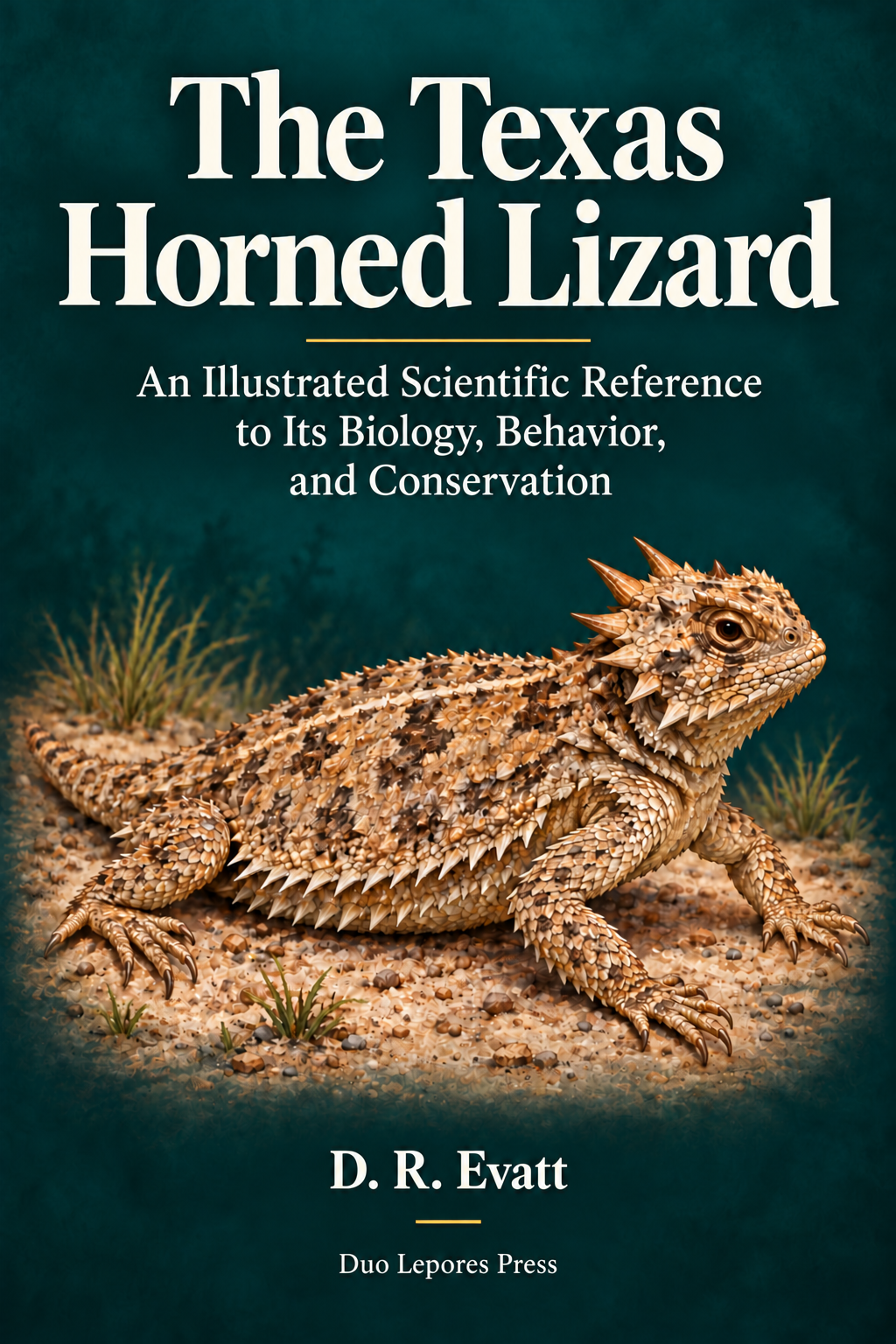
An Illustrated Scientific Reference to Its Biology, Behavior, and Conservation
Look beyond the familiar outline
A small lizard. A substantial story.
The Texas horned lizard is recognizable at a glance, yet its life raises questions that reach far beyond its horns. How does its skin convey water? What shapes its feeding and daily activity? How do researchers distinguish a local loss from a broader population change?
This volume examines the species through its anatomy, distribution, evolution, reproduction, behavior, and conservation. Drawings and explanatory figures accompany the text, while a glossary and full references give readers ways to follow unfamiliar terms and pursue the underlying literature. Research findings are presented with attention to the places, methods, and limits that give them meaning.
Texas horned lizard guide: identification, diet, rain harvesting, and conservation
A reader’s guide from Duo Lepores Press · Updated November 18, 2026
Is a Texas horned lizard really a toad?
The Texas horned lizard, Phrynosoma cornutum, is a reptile. Its broad, flattened body explains the familiar names “horny toad” and “horned toad,” but those names can hide how different it is from an amphibian. Its scales, claws, and anatomy belong to a lizard, and its place in nature is best understood by looking beyond the nickname.
The book The Texas Horned Lizard examines that animal through its biology and the research used to study it. The guide below introduces several of its central subjects, from the horns and scales visible in a photograph to the less obvious connections between prey, water, shelter, and population survival. It is a reference for understanding the species, rather than a pet-care manual.
Scientific names help keep those subjects attached to the right animal. Phrynosoma identifies the horned-lizard genus, while cornutum identifies the Texas species. Other horned lizards share the general body plan, so a statement about the genus does not necessarily describe every species within it.
How can you recognize a Texas horned lizard?
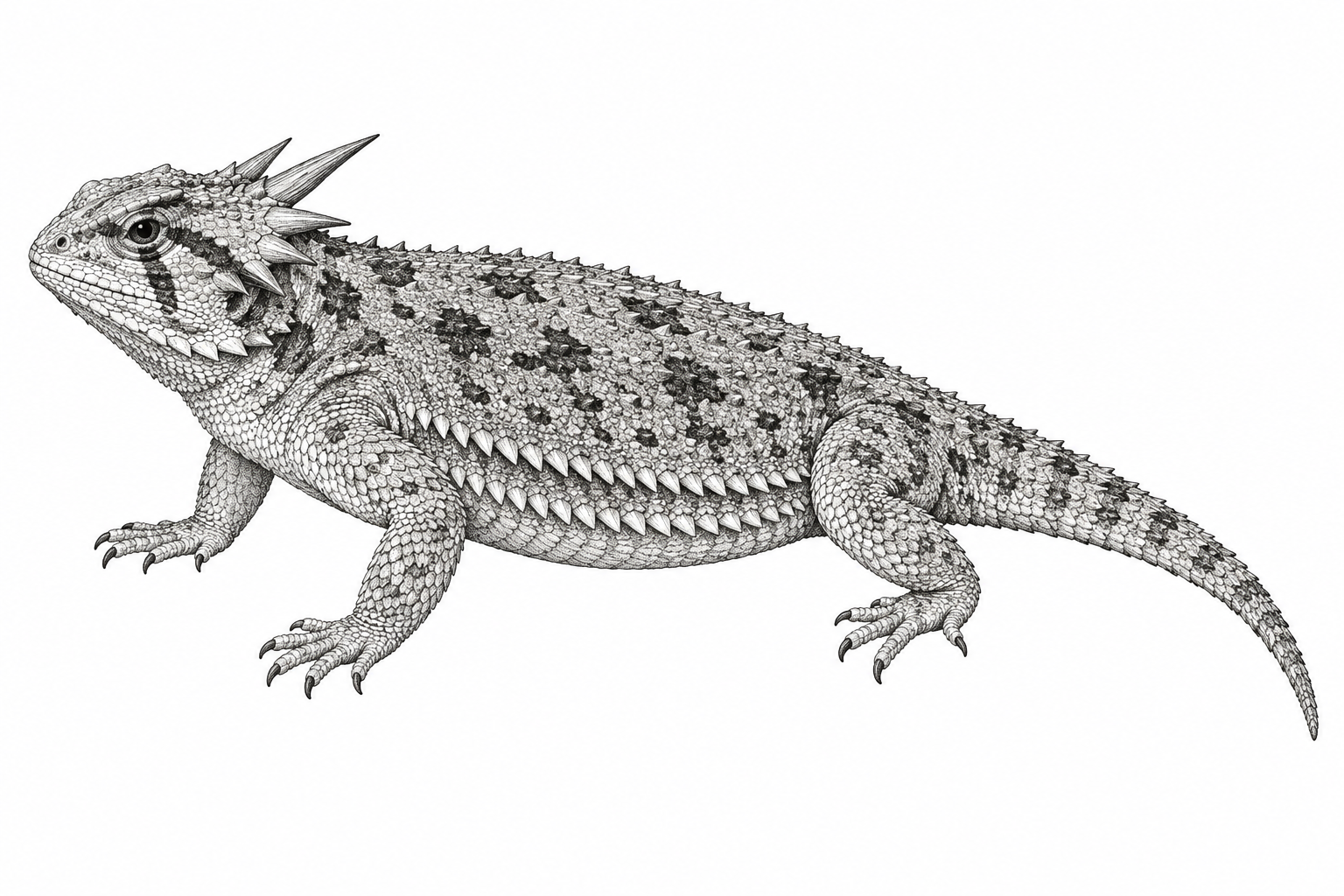
The Texas species has a conspicuous pair of long horns at the back of the head and two rows of enlarged fringe scales along each side of the body. A pale line often runs down the back, and the overall coloration varies. The combination of structural features is more informative than whether one animal looks especially brown, reddish, or gray.
“Two long horns” refers to the prominent rear pair, not to the total number of projections around the head. Confusing those two meanings can make a perfectly ordinary horned lizard seem to have the wrong anatomy. Young animals, the angle of a photograph, and the position of the body can also make features harder to see.
The round-tailed horned lizard has a different outline, with shorter rear horns and no enlarged abdominal fringe. Short-horned lizards have reduced head horns. These comparisons help explain why a broad body alone cannot settle identification; location and a clear view of the relevant structures also matter. The book’s drawings separate these features so readers can understand what they are looking at.
Interpretive illustration from the book: an adult Texas horned lizard in lateral view. Proportions and scale patterns vary; this is not a measured specimen.
Where do Texas horned lizards live?
The native distribution extends beyond Texas into other parts of the south-central and southwestern United States and northern Mexico. Within that broad region, occurrence is uneven. A species-range map describes a geographic extent, not a promise that the animal occupies every field or county inside a colored boundary.
The landscape is equally important at a much smaller scale. The lizards use open ground as well as vegetation and shelter. Soil suitable for burrowing, access to prey, and places with different thermal conditions contribute to the usefulness of a site. An expanse that appears open to a person may still lack some of those resources.
Records from introduced populations require a separate explanation. The manuscript discusses coastal South Carolina populations as examples of animals living outside the native range. Their history and ecology should not be silently merged into a map of natural distribution. A dot on a map becomes more informative when its date, origin, and supporting evidence are known.
What do Texas horned lizards eat?
Ants are central to the species’ feeding ecology, and harvester ants are prominent in many accounts. That does not mean every population has the same diet or that every ant eaten belongs to the same genus. The book compares studies from different places to show both the importance of ants and the variation within that specialization.
For example, research at Tinker Air Force Base in Oklahoma recovered a diet dominated by other ants, with no harvester ants in the sampled scats. Studies of introduced South Carolina populations also provide evidence that a simple “harvester ants only” description is too narrow. Those findings broaden our understanding of prey use without showing that all ant communities provide equivalent food resources.
Diet studies also depend on what is counted. The number of identifiable ant heads in scat is not the same as the weight of food consumed, and a sample of scats is not automatically a sample of the same number of independent lizards. These distinctions help readers understand why one impressive percentage should not be repeated as a universal rule.
Feeding and shelter are connected. A lizard may spend much of its time under cover but move into a more open area to take prey. Preserving only the place where it was first seen can therefore miss another part of the habitat it uses. The manuscript develops these questions in its chapter on diet, ants, and feeding mechanics.
How does a horned lizard collect rainwater?
Texas horned lizards can collect water on the surface of the body and convey it through the spaces between scales toward the mouth. The water is then ingested. Describing the process as drinking through the skin misses that route: collection on the skin and absorption through the skin are different things.
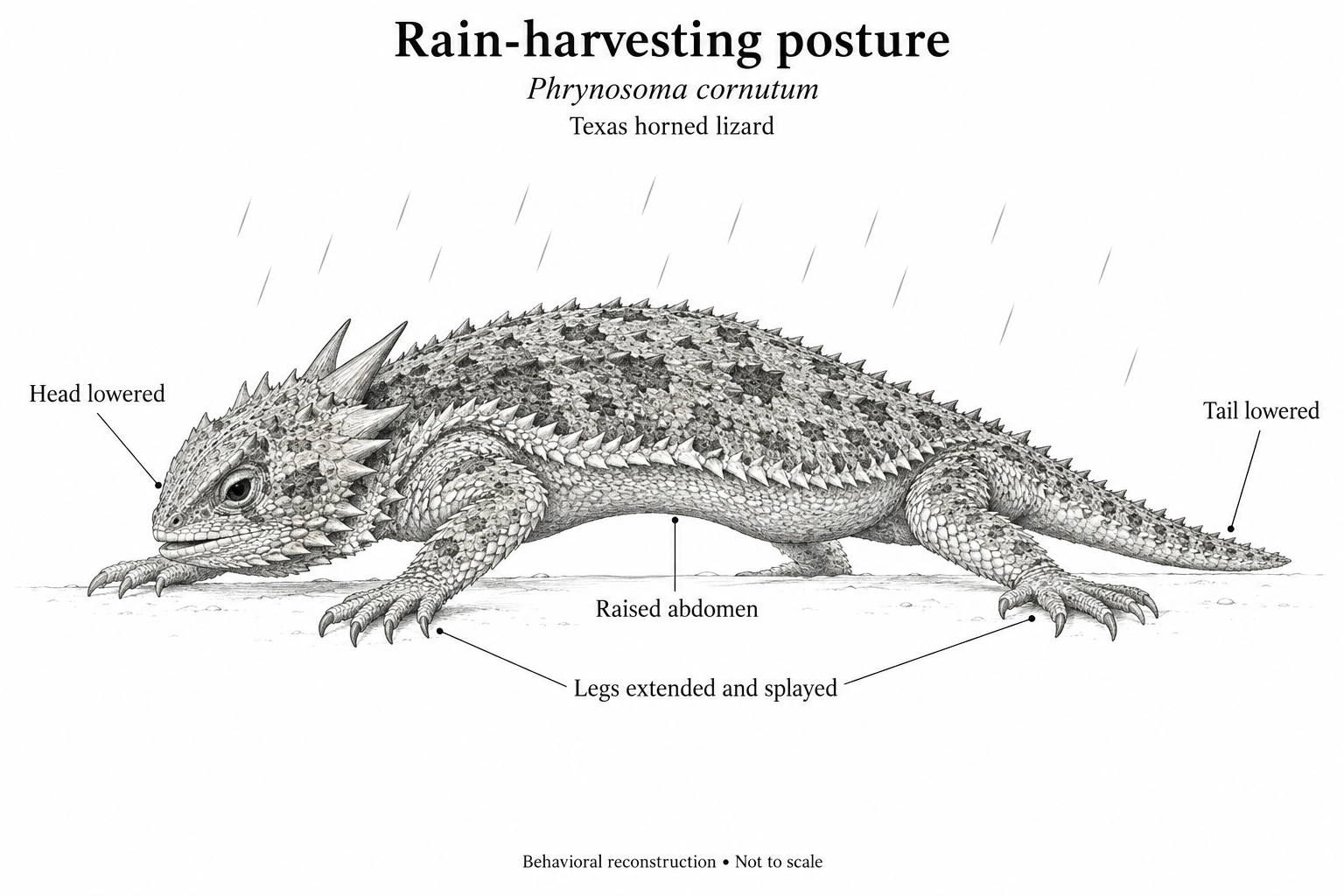
Rain-harvesting observations include a characteristic posture, with the abdomen raised, the head and tail lowered, and the legs spread. Repeated jaw movements accompany the behavior. The illustration on this page reconstructs that posture; it is an explanation of behavior rather than a measured anatomical specimen.
Experiments have examined how water travels over the surface, how the channels between scales are arranged, and how water reaches the animal’s mouth. Together, those approaches connect a visible behavior to structures that are difficult to see without magnification.
A laboratory measurement of the speed of water movement does not directly state how much a wild lizard drinks during a storm. Channel geometry, rainfall, surface conditions, and ingestion all affect the complete process. The book retains those distinctions while explaining why the skin has attracted interest from both biologists and researchers studying water-transport materials.
Rain-harvesting posture reconstructed for the book: raised abdomen, lowered head and tail, and spread legs. This illustration explains a behavior; it is not an anatomical measurement.
How do heat, shade, and daily activity fit together?
A horned lizard’s body temperature is influenced by the conditions around it and by where it places itself. Sunlit ground, shade, vegetation, and buried refuges can offer different conditions within a short distance. The animal’s use of those places helps explain why habitat cannot be judged by air temperature or plant cover alone.
Activity also changes with season and circumstances. The time suitable for feeding or movement may narrow when exposed surfaces become too hot, while cooler conditions create a different set of limits. A lizard that is not visible may be using shelter rather than having disappeared from the area.
The manuscript compares thermal research with attention to the conditions under which measurements were made. A temperature selected in a laboratory, a body temperature recorded in the field, and a physiological limit answer different questions. Keeping those measures separate avoids turning one study into an overly simple rule about when the animal must be active.
Do Texas horned lizards really squirt blood from their eyes?
Yes. Blood-squirting is one of the species’ documented defensive responses, but it belongs to a larger set of ways of dealing with predators. Concealment, remaining still, changes in posture, and the physical effects of horns and body shape also matter. A lizard’s response can depend on the threat it faces.
Research on mammalian predators has examined the effect of the expelled blood, including aversive responses in foxes and coyotes. Those experiments support a defensive chemical effect under the tested conditions. They do not show that the blood is a universal poison or that every attack ends with the lizard escaping unharmed.
The difference is important when interpreting an image or a short video. Seeing blood emerge establishes that a discharge occurred; it does not by itself establish how a predator responded or whether the lizard survived afterward. The book’s treatment follows those separate questions rather than reducing the defense to a spectacular anecdote.
What can size tell us about age and reproduction?
Texas horned lizards lay eggs. Their reproductive biology includes the timing of breeding and nesting, egg development, hatchlings, and the conditions affecting survival as young animals grow. Those processes unfold in environments that differ across the species’ range, so a calendar reported from one region should not automatically be applied everywhere.
Size is useful, but it is not a birth certificate. Adult males and females can overlap in size, and a photograph without a scale does not provide a dependable length. Studies may define juveniles and adults using specific measurement criteria; those categories should be understood before results from different studies are combined.
The same care applies to sex identification. Body length alone is not enough. Anatomical features around the tail base and the underside of the thighs can contribute evidence when they are visible, while a poorly positioned photograph may leave the answer unresolved. The book includes explanatory anatomical comparisons and discusses the difference between an observed feature and an inference.
Why have Texas horned lizards declined in parts of their range?
The manuscript reviews several pressures rather than assigning every disappearance to one cause. Habitat loss and fragmentation can alter where animals feed, shelter, and move. Changes in ant communities affect the food available, while roads, chemical exposure, and other disturbances can add further constraints. The effects depend on the place and the combination of pressures present.
Fire ants are often prominent in public explanations, but their role should be considered alongside habitat change and the wider prey community. The presence of one suspected pressure does not establish that it caused every local decline. Research becomes more informative when it can compare conditions, track outcomes, and account for other changes at the site.
Texas Parks and Wildlife lists the species as threatened in Texas. That state designation should be read at its stated geographic level rather than converted into a claim about every jurisdiction. The TPWD species account provides the agency’s identification, habitat, and status summary.
Understanding decline also requires care with absence. Fewer reported sightings may reflect fewer animals, less searching, different weather, or changes in detectability. Repeated, comparable observations provide a stronger basis for discussing population change than a single unsuccessful visit.
What would demonstrate a successful conservation effort?
Conservation work can involve habitat management, captive breeding, headstarting, or moving animals to suitable sites. These are different interventions. Headstarting generally means raising young animals through an early vulnerable period before release; it should not be treated as identical to breeding a self-sustaining wild population.
A release total describes an action taken. Survival after release, successful reproduction, and persistence over multiple years describe outcomes. The book follows these distinctions because they affect what a program’s results can reasonably show. An encouraging short-term result deserves attention without being promoted into evidence of permanent recovery.
Site conditions remain part of the explanation. Animals need more than a release location: prey, shelter, thermal opportunities, and the surrounding landscape influence what happens afterward. Monitoring also has to distinguish a confirmed death from an animal whose fate is unknown.
The reference brings these subjects together with its chapters on population biology, genetics, threats, habitat management, and release research. Readers can begin with the illustrated preview of the identification chapter or continue to the Hey, Horny Toad! science pages for related introductions. The picture books about Torito are separate works for young readers; this volume examines the real animal and the evidence used to understand it.
Sources and reading notes
Based on D. R. Evatt’s The Texas Horned Lizard manuscript: identity and appearance; distribution; anatomy; diet; water balance; thermal biology; reproduction and growth; defensive behavior; population biology; threats; and conservation. Research discussed there includes Ramakrishnan et al. (2018), Heuring et al. (2019), Sherbrooke (1990), Comanns et al. (2011, 2015), and the predator-response studies of Sherbrooke and colleagues. The preview is selected from the current book proof.