
Gaius Duilius was the Roman consul who defeated a Carthaginian fleet at Mylae in 260 BC, during the First Punic War. The victory demonstrated that Rome could challenge Carthage in a major fleet action, and the boarding device known as the corvus became the best-known feature of the battle.
How did Duilius take command of the fleet?
In Polybius’s account, Duilius initially commanded the land forces, while his consular colleague Gnaeus Cornelius Scipio took a small naval force toward Lipara and was captured. When news reached Duilius, he entrusted his legions to the military tribunes and went to the fleet. His naval fame thus began with a change of responsibility during an already difficult campaign. [1]
This context matters because Rome’s learning at sea was neither instantaneous nor uninterrupted. Polybius describes hurried preparation, crews practicing together, and setbacks alongside successes. Mylae was a major breakthrough within that process, rather than the moment when a people wholly unacquainted with ships suddenly discovered the Mediterranean.
What was the corvus?
The corvus, whose name means raven or crow, was a boarding bridge described by Polybius. A raised gangway could be dropped onto an opposing ship, with an iron spike gripping the deck and holding the vessels together. Roman soldiers could then cross to fight at close quarters. [2]
Its purpose was to change the kind of encounter the Roman crews faced. Instead of relying entirely on maneuvering and ramming, they could try to make contact produce a boarding action. That did not make sailing skill unnecessary, since a ship still had to reach an opponent and survive the approach, but it offered a way to exploit the fighting ability of men on deck.
Polybius attributes the suggestion to an unnamed person, so the frequent statement that Duilius invented the corvus goes beyond his evidence. Duilius commanded the fleet that used it successfully at Mylae; the identity of its inventor is another question. Nor should a modern drawing of the device be mistaken for a surviving ancient engineering plan.
What happened at the Battle of Mylae?
Mylae, near modern Milazzo on Sicily’s northern coast, was the scene of the encounter in 260 BC. Polybius describes the Carthaginians approaching confidently and without the order their situation required. The leading ships were caught by the boarding devices, and Roman soldiers crossed onto their decks, turning those encounters into close fighting. [3]
Other Carthaginian vessels tried to use their maneuverability to attack from different directions, but the account describes the devices being brought around to meet them. The Carthaginian commander escaped, while his fleet suffered substantial losses. Polybius gives fifty ships as the total lost; this is the ancient historian’s figure, rather than a count independently established by modern evidence.
The commander opposing Duilius is named Hannibal in this account, but he was not the Hannibal who later crossed the Alps. Repeated Carthaginian names can cause as much confusion as repeated Roman ones, particularly when an account moves quickly between the two Punic Wars.
Why did Romans remember the torch and flute?
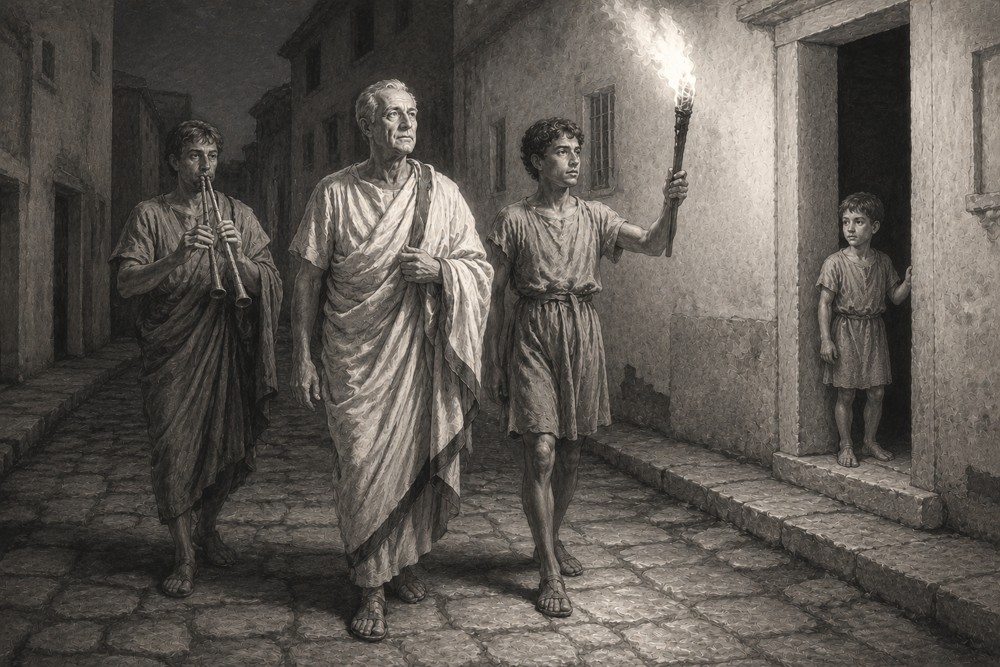
Duilius’s victory remained part of Roman public memory long after his command ended. In Cicero’s On Old Age, the speaker Cato recalls Duilius enjoying the accompaniment of a torchbearer and flute player when returning from dinner, an unusual distinction associated with his naval achievement. The passage is part of Cicero’s literary dialogue, written much later, and it shows how a public victory could become attached to a recognizable personal custom. [4]
The scene has an appealing domestic scale after the crowded decks at Mylae. Rome’s naval hero comes home from dinner with music and light, carrying the memory of the battle into an ordinary evening. The illustration below evokes that tradition without pretending to be a contemporary portrait.
Did Mylae end the First Punic War?
No. The war continued until 241 BC, almost two decades after Duilius’s victory. Mylae made Roman success at sea credible, but further campaigns, defeats, losses of fleets, and renewed building still lay ahead. The settlement eventually reached after the fighting off the Aegates Islands belongs to the career of Lutatius, not Duilius. [5]
For that later stage, see our guide to the Treaty of Lutatius. Marco Valenti’s book on Duilius concentrates on the earlier breakthrough and the evidence for the man whom Romans associated with it.
Read Gaius Duilius by Marco Valenti
The free 8-page PDF includes the title page and the introduction and its notes. These are selected pages from the book PDF, with their original typography and pagination retained; gaps in page numbers reflect the selection.
Sources and further reading
The guide above is a modern explanation of the evidence. The links below identify the ancient passages and, where indicated, modern commentary used in preparing it.
- Polybius, Histories I.20–23: the fleet and the transfer of command.
- Polybius I.22: the description of the boarding device.
- Polybius I.23–24: Mylae and its immediate consequences.
- Cicero, On Old Age 44: Duilius, the torchbearer, and the flute player.
- Polybius I.59–63: the final campaign and peace of 241 BC.