
Appius Claudius Caecus was the Roman censor of 312 BC associated with the Via Appia and the Aqua Appia. His career also belongs to the history of political conflict within Rome and to the tradition of resistance to Pyrrhus. His name means Appius Claudius “the Blind,” although the familiar image of an elderly, blind statesman comes from a later stage of his life.
What did Appius Claudius build?
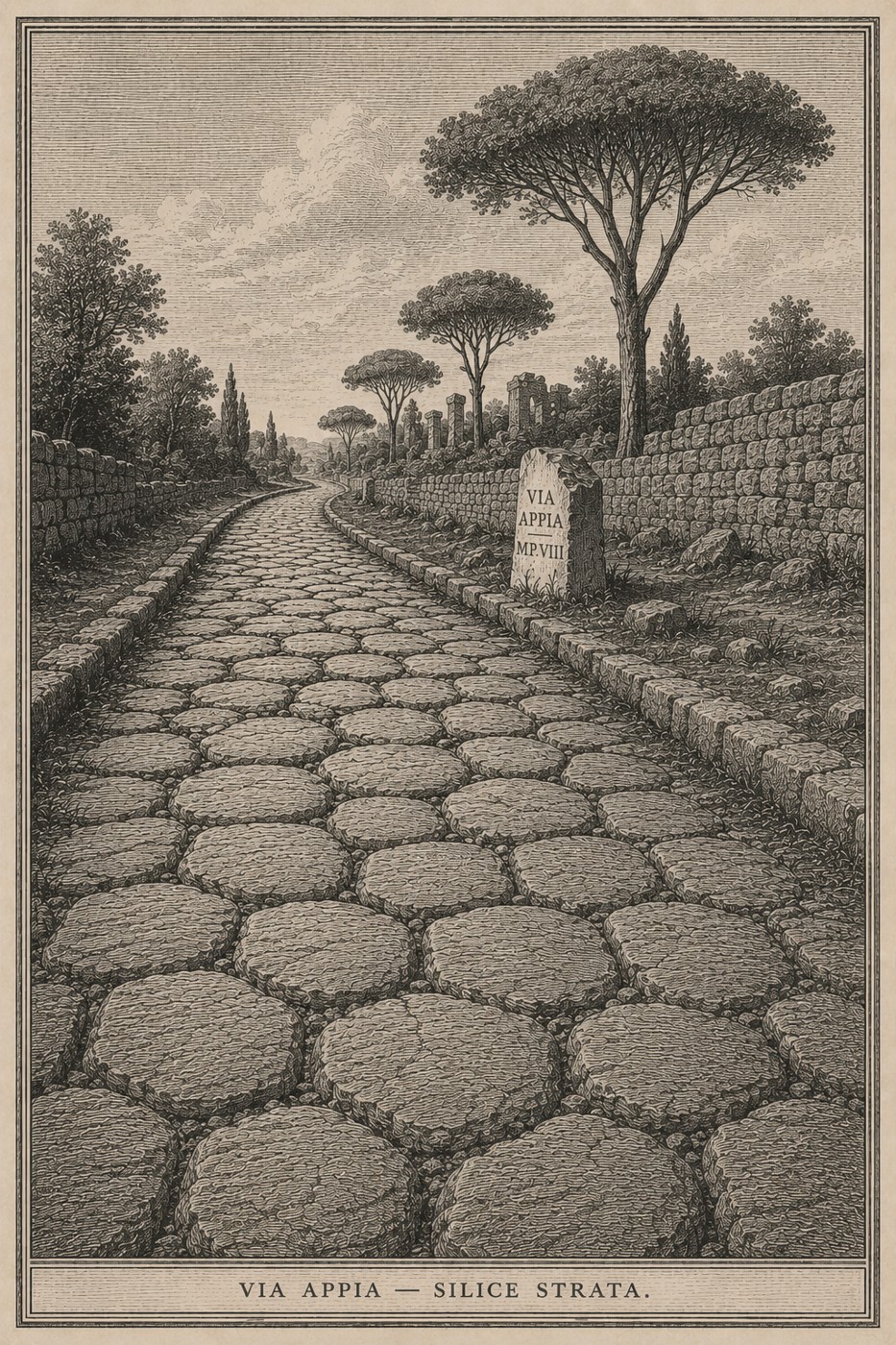
The Via Appia originally connected Rome with Capua, giving the Republic a major route toward the south. Its eventual extension toward Brundisium belongs to the road’s longer history, so the complete later route should not be credited to the censor’s initial project. Frontinus explicitly associates Appius with the road from the Porta Capena to Capua as well as with Rome’s first aqueduct. [1]
Those works linked the needs of an expanding state with the needs of its capital. A road could carry soldiers, officials, travelers, and goods, while an aqueduct brought a more dependable supply of water into the city. Their usefulness outlived the particular circumstances that led to their construction, which helps explain why Appius remains visible where many other early Republican officeholders have faded.
Was the Aqua Appia carried on high arches?
Mostly it was not. Frontinus describes the Aqua Appia as running overwhelmingly underground, with only a short section above ground. The magnificent arcades commonly associated with Roman aqueducts are therefore a misleading way to picture this first supply. An aqueduct was a system for conducting water, not necessarily a procession of monumental arches. [1]
Frontinus also preserves a colleague’s contribution. Gaius Plautius was associated with finding the springs, although Appius’s name became attached to the aqueduct. Public works required more people than the person eventually commemorated in their names, and the surviving account allows us to recover a little of that shared responsibility.
Why was his censorship contentious?
A Roman censor’s work extended beyond building. It included the organization and assessment of the citizen body and the revision of the Senate’s membership, which gave the office considerable political importance. Livy’s account of Appius’s censorship connects his lasting fame with the road and aqueduct but treats his handling of the senatorial list with hostility. [2]
Livy also describes Appius continuing in office after his colleague’s departure and reports a tradition that connected his later blindness with changes to the cult of Hercules. That religious explanation belongs to the ancient account of punishment and impiety; it is not a medical explanation that a modern biography can simply adopt.
These passages show how admiration and suspicion could coexist. The builder’s achievements were difficult to overlook, while his conduct could still be arranged into a story about the dangerous pride of the Claudian family. Reading that family reputation as a theme in the narrative helps prevent it from becoming an unquestioned explanation of every decision he made.
What did he say about peace with Pyrrhus?
Plutarch describes an elderly and blind Appius being carried to the Senate when Rome was considering proposals brought by Pyrrhus’s envoy Cineas. In the speech attributed to him, Appius argues that making peace while the king remained in Italy would reward aggression and encourage other enemies. The senators then reject the proposals on those terms. [3]
The scene gives Appius a final public role as the voice of Roman determination, but Plutarch’s version was written centuries after the event. It should be presented as the surviving literary account of the intervention, not as a stenographic record. The distinction lets us discuss its political argument without inventing certainty about the exact words spoken.
The argument also connects this biography with the careers of Manius Curius Dentatus, who later faced Pyrrhus at Beneventum, and with the agreements between Rome and Carthage during the king’s Italian venture. These were different responses to the same difficult question of how Rome should deal with a formidable foreign commander.
Which Appius Claudius is this?
Roman families reused names, and Appius Claudius Caecus should not be confused with the Appius Claudius associated with the fifth-century decemvirate. The censor of 312 BC belongs to a later period, when Rome was expanding its reach through Italy. Keeping the office and date attached to the name is a simple way to avoid combining separate lives.
Marco Valenti’s biography brings together the builder, the controversial censor, and the remembered opponent of accommodation with Pyrrhus. Its opening sample introduces the surviving sources before the narrative follows the career in detail.
Read Appius Claudius Caecus by Marco Valenti
The free 9-page PDF includes the title page and the introduction and its notes. These are selected pages from the book PDF, with their original typography and pagination retained; gaps in page numbers reflect the selection.
Sources and further reading
The guide above is a modern explanation of the evidence. The links below identify the ancient passages and, where indicated, modern commentary used in preparing it.