
Manius Curius Dentatus was the Roman commander associated with the defeat of Pyrrhus at Beneventum in 275 BC and with the beginning of the Anio Vetus aqueduct. Later Romans also remembered him as the man who preferred a modest meal to Samnite gold, making his life a meeting point between military history and Rome’s ideals of public service.
Dentatus, the Samnite ambassadors, and the turnips
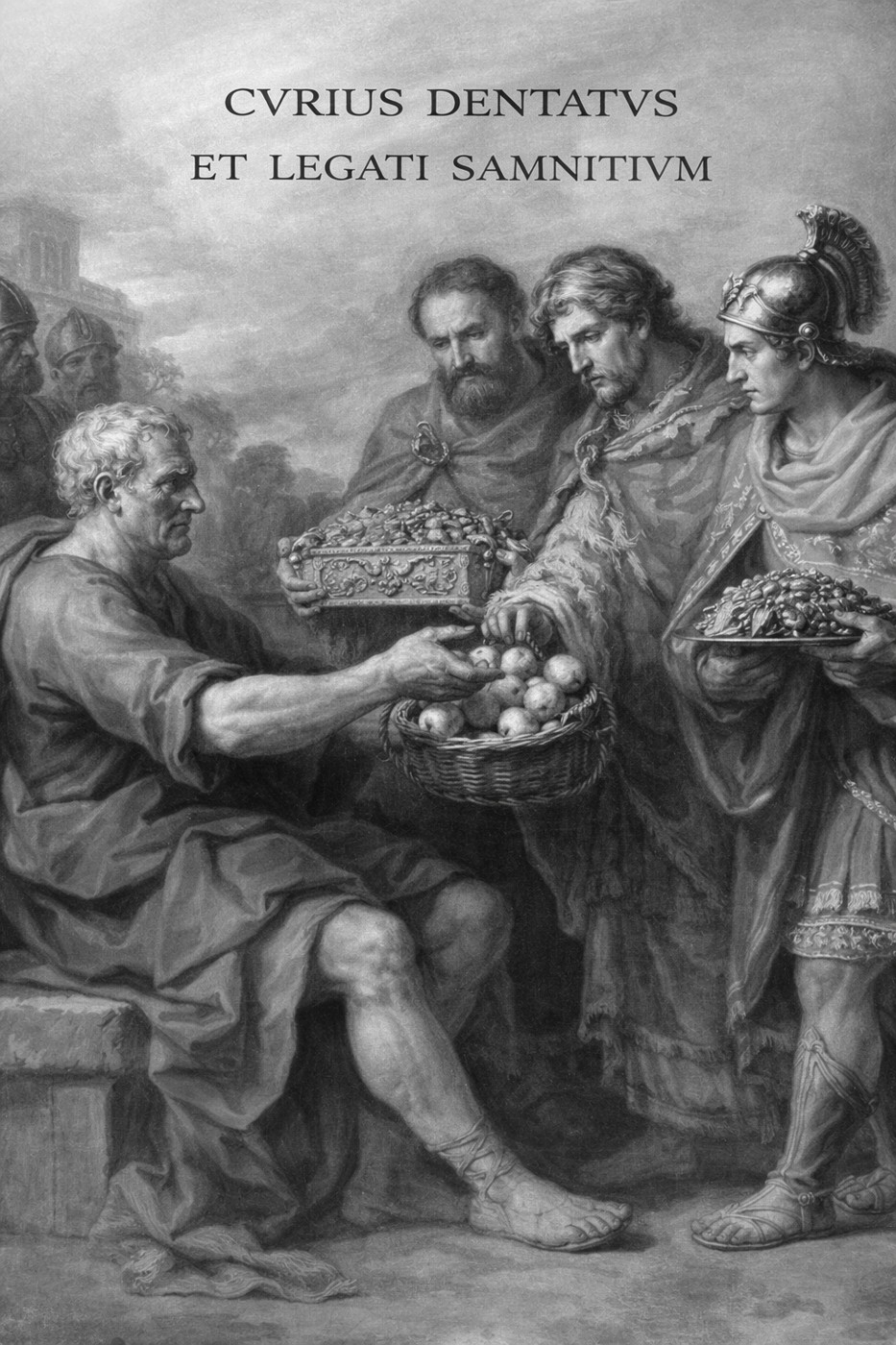
In Plutarch’s Life of Cato the Elder, the young Cato draws inspiration from the small farm once occupied by Manius Curius. The place recalls a celebrated scene: Samnite ambassadors find the victorious Roman cooking turnips and offer him gold, which he refuses because his simple needs leave him no use for it. The account then gives his refusal a sharper edge, explaining that he prefers conquering those who possess gold to possessing it himself. [1]
The modest dinner can make Dentatus sound like a man who has withdrawn from power, although the story actually places simplicity beside conquest. His lack of appetite for personal luxury makes him an exemplary ruler in the telling; it does not make him indifferent to Rome’s supremacy. That combination helps explain why later writers found him so useful.
Plutarch wrote long after Dentatus’s lifetime, and the scene serves a moral purpose within a biography of someone else. We can describe it accurately as an ancient tradition about his integrity without claiming to know the exact words spoken beside the hearth. The anecdote’s later influence is much easier to establish than its dialogue.
How did Dentatus defeat Pyrrhus?
Pyrrhus of Epirus had come to Italy with an experienced army and elephants, and his victories had already demonstrated that Roman armies could be beaten. Yet winning a battle and securing a durable settlement were different tasks. After campaigning in Sicily, he returned to an Italian war in which support from his allies had weakened. [2]
Plutarch describes Pyrrhus dividing his forces before attacking the army of Manius Curius near Beneventum. A night approach through difficult, wooded country went wrong, and the attackers arrived in daylight after losing time and cohesion. Curius struck the exposed troops, then fought a further engagement in which the elephants initially put part of the Roman line under severe pressure.
The decisive reversal in Plutarch’s account came when fresh Roman troops attacked the animals with missiles, driving them back into their own ranks. This account gives the elephants a dramatic part, but the surrounding sequence also matters: the failed approach, the Roman camp, and the availability of troops who had not yet exhausted themselves all shaped the fighting. [2]
Beneventum marked the end of Pyrrhus’s attempt to secure his position in Italy. It did not kill him or end his career; he returned to the Greek world and continued fighting there. Treating the battle as the conclusion of his Italian venture preserves its importance without turning it into the end of every conflict involving the king.
The Anio Vetus: victory put to public use
Dentatus also appears in a very different kind of source. Frontinus, writing about Rome’s water supply, records that he contracted for the aqueduct later called the Anio Vetus, using booty taken from Pyrrhus. The project began in 272 BC, forty years after the Aqua Appia, Rome’s first aqueduct. [3]
Frontinus distinguishes beginning the project from completing it. Curius was later appointed to a two-man commission charged with bringing in the water, but died shortly afterward, leaving Fulvius Flaccus to receive the credit for completion. Calling Dentatus the aqueduct’s initiator is therefore more precise than implying that he personally saw the finished supply enter Rome.
The aqueduct places his career within the practical transformation of the city. War brought resources into Roman hands, and those resources could finance works that changed daily life. Alongside the image of the commander at his modest hearth stands a public figure involved in substantial expenditure and long-term construction.
What survives of the man?
These sources preserve different Dentatuses because they ask different questions. Plutarch uses his frugality to illuminate Cato’s character and his generalship to explain Pyrrhus’s fortunes, while Frontinus records responsibility for a public work. Reading them together gives us a fuller view than repeating the turnip story alone, provided we keep their purposes visible.
Marco Valenti’s biography examines the career behind that celebrated example of Roman virtue. Its opening pages, available below, introduce both the surviving evidence and the difficulty of recovering an early Republican life from accounts written for later audiences.
Read Manius Curius Dentatus by Marco Valenti
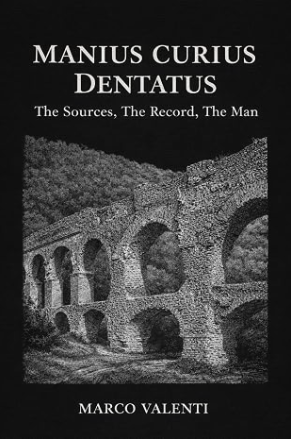
The free 15-page PDF includes the title page and the introduction and its notes. These are selected pages from the book PDF, with their original typography and pagination retained; gaps in page numbers reflect the selection.
Sources and further reading
The guide above is a modern explanation of the evidence. The links below identify the ancient passages and, where indicated, modern commentary used in preparing it.