
The Treaty of Lutatius ended the First Punic War in 241 BC. Rome and Carthage agreed that Carthage would withdraw from Sicily, release Roman prisoners without ransom, and pay an indemnity ultimately fixed at 3,200 talents. The settlement takes its name from the Roman commander Gaius Lutatius Catulus. Its terms survive principally in two accounts by the Greek historian Polybius, rather than in an original treaty document.
A peace treaty can look straightforward when reduced to a date and a payment. This one was less straightforward for the people who negotiated it. The agreement reached in Sicily still required approval at Rome, where the terms were made harder; several years later, Rome demanded Sardinia and another payment. Keeping those stages separate explains both what the treaty accomplished and why its aftermath became so bitter.
Why did Rome and Carthage make peace in 241 BC?
The First Punic War began in 264 BC and developed into a prolonged struggle over Sicily. By its final years, neither power could end it cheaply. Carthaginian forces still held positions in the west of the island, while Rome had repeatedly paid the cost of building fleets and losing ships. Hamilcar Barca could continue fighting on land, but his army depended on supplies reaching Sicily by sea.
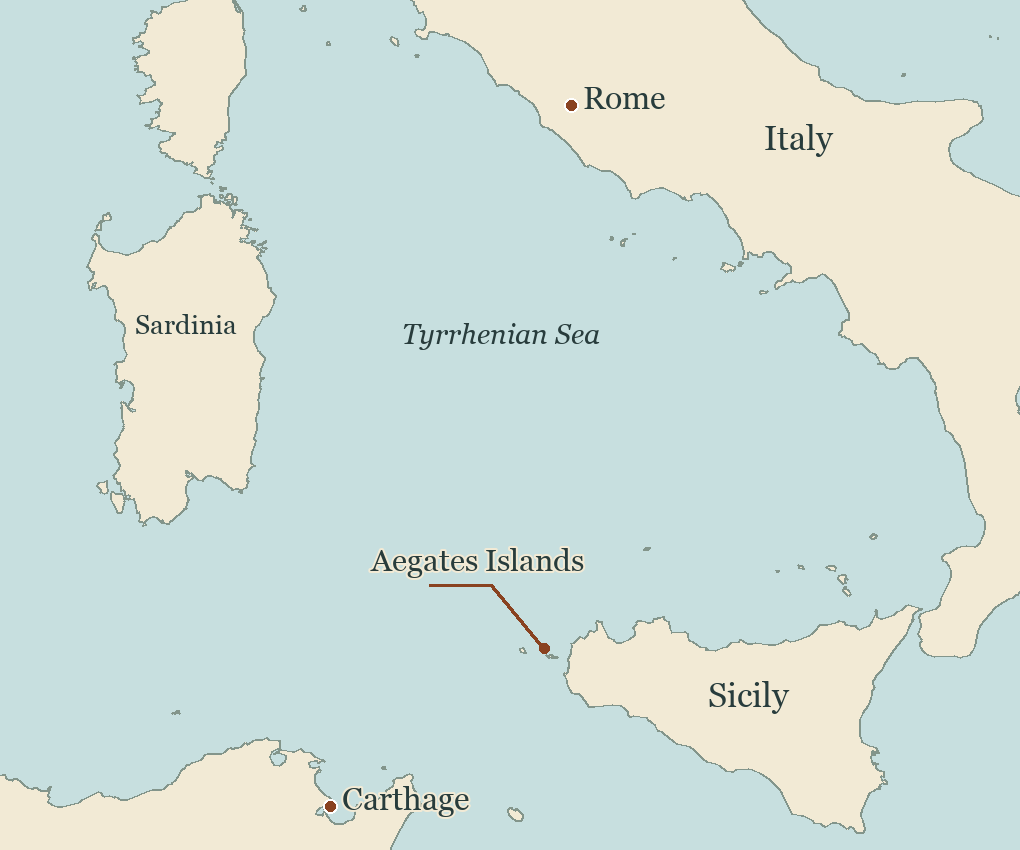
Rome’s renewed naval effort changed that calculation. Polybius describes a fleet financed through contributions from wealthy citizens, with repayment expected if the expedition succeeded. Under Gaius Lutatius Catulus, the Roman crews trained for the encounter that would decide whether Carthage could continue supplying its army. The Carthaginian relief fleet came laden with provisions and hoped to join Hamilcar before fighting. Lutatius intercepted it near the Aegates Islands, now usually called the Egadi Islands, off western Sicily.
The Roman victory in 241 BC deprived Carthage of a practical way to sustain the Sicilian campaign. Polybius presents the decision for peace as a calculation of resources: the desire to continue was not enough when there was no convincing means of doing so. Carthage gave Hamilcar authority to deal with the situation, and he sent representatives to negotiate. Lutatius was willing because Rome, too, was worn down by the war. [1]
The treaty’s name can therefore mislead if it suggests the work of a single man. Lutatius was the Roman commander associated with the agreement; Hamilcar acted for Carthage, and the Roman people and commissioners subsequently determined whether the proposed settlement would stand. The final peace emerged from this sequence of military necessity, negotiation, and approval.
What were the terms of the Treaty of Lutatius?
Polybius first describes the terms agreed at the end of the campaign, then explains how Rome revised them. His later account in Book III gives a fuller list of the final provisions. The following table keeps the preliminary agreement distinct from the settlement that followed. It summarizes the sources in modern English; it is not a surviving text or a reconstruction of the treaty’s original wording. [2] [3]
| Subject | Preliminary agreement | Final settlement |
|---|---|---|
| Sicily | Carthage was to evacuate the whole island. | Withdrawal from Sicily remained a central obligation. |
| Other islands | Not specified in Polybius’s initial summary. | Carthage also had to leave the islands between Sicily and Italy. |
| Indemnity | 2,200 Euboean talents over twenty years. | 1,000 talents immediately, plus 2,200 within ten years: 3,200 in total. |
| Prisoners | Roman prisoners were to be returned without ransom. | This obligation remained. |
| Allies | Explicit protection for Hiero, Syracuse, and Syracuse’s allies. | Book III records protection for the allies of both parties and restrictions on interference. |
| Approval | The agreement was conditional on acceptance by the Roman people. | Ten Roman commissioners examined and tightened the terms after the original proposal was rejected. |
Read The Treaty of Lutatius by Marco Valenti
Rome rejected the first peace its own consul negotiated. With the original treaty lost, how can we tell what changed? Marco Valenti follows the evidence in The Treaty of Lutatius: The Peace That Ended the First Punic War.
Read “Polybius at the Tablets,” the illustrated excerpt from Part I, with the author’s notes.
The indemnity: why both 2,200 and 3,200 appear
These figures describe different stages of the agreement. The proposal negotiated in Sicily called for 2,200 talents over twenty years. Rome then added 1,000 talents and halved the payment period for the balance. Polybius’s Book III specifies that the additional 1,000 was due immediately, while the 2,200 was to be paid within ten years. An account that gives only one figure without explaining the stage can leave the impression that the sources contradict themselves.
A talent was a unit of weight used to reckon large sums, not an individual coin. The original proposal specifies Euboean talents of silver. A modern cash equivalent would require assumptions about metal values, purchasing power, and the ancient economy, so the payment schedule is often the more useful measure of the burden. Carthage faced both a substantial immediate payment and a much shorter timetable for the remainder.
Allies and interference
The settlement concerned political relationships as well as land and money. In Book III, Polybius records mutual protection for allies and prohibitions involving contributions, public buildings, and military recruitment in the other party’s dominions. Neither side was to form alliances with the other’s allies. These provisions sought to limit interference that could weaken a state without an outright invasion. Their later interpretation mattered because Rome and Carthage did not agree about how protection applied to allies acquired after the treaty. [3] [5]
Why Rome could change the proposed peace
The preliminary agreement expressly depended on approval by the Roman people. When they refused the terms as submitted, ten commissioners were sent to examine the settlement. Their revisions increased the indemnity, shortened the time allowed to pay, and added the islands between Sicily and Italy. This was not a commander concluding a peace that Rome had already promised to accept unconditionally: ratification had been left open in the proposal itself. The financial difference was nevertheless considerable for Carthage. [2]
Does the original Treaty of Lutatius survive?
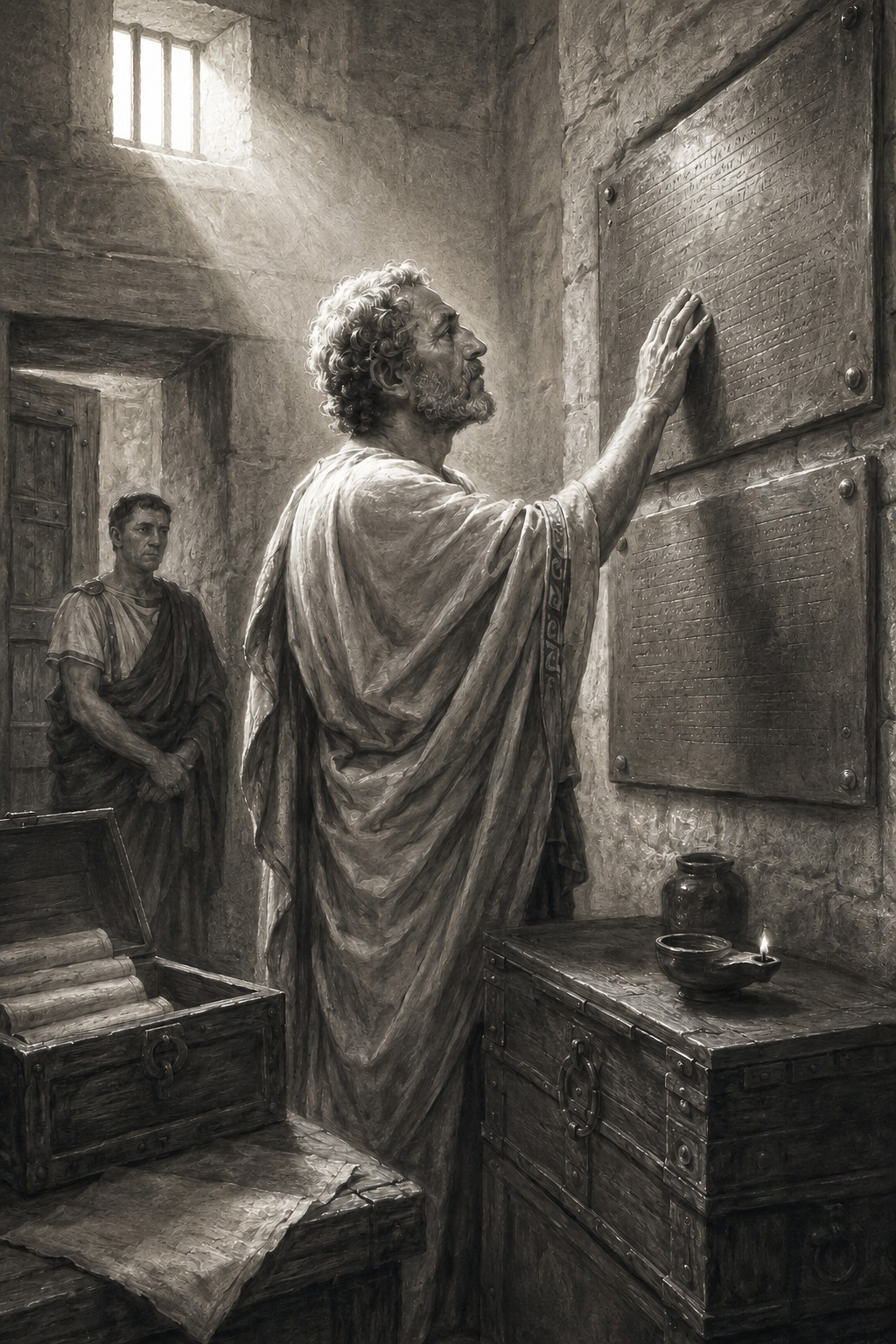
No original tablet or complete verbatim text is available to us. The principal evidence is Polybius’s Histories, especially I.62–63 and III.27. Book I places the agreement in the story of the war’s end, while Book III returns to its clauses in a discussion of Roman–Carthaginian relations and responsibility for the later war.
The two passages serve different purposes and should be read together. The first explains the preliminary bargain and its revision; the second supplies reciprocal clauses and an explicit payment schedule. Combining their information is useful, but a modern combined presentation should be labeled as a summary or reconstruction. It should not imply that the reader is looking at a single ancient document preserved intact.
Polybius also describes earlier agreements between Rome and Carthage kept on bronze tablets in the Roman treasury, and the difficulty of understanding archaic Latin. That passage is important evidence for his treatment of diplomatic documents. It does not give us a photograph of the 241 BC treaty or establish every ceremonial formula that a modern editor might restore to it. Oaths, introductory language, and reconstructed Latin need their own explanation of what is attested and what is inferred. [4]
His account must also be read as history written with an argument in view. In Book III the treaties form part of an inquiry into the causes of Hannibal’s war. Readers can follow his evidence while examining the conclusions he draws from it, especially when he interprets the protection owed to allies. Clear sourcing lets the reader distinguish the reported provisions from the historian’s legal and political reasoning.
Was Sardinia part of the treaty of 241 BC?
The demand that Carthage surrender Sardinia belongs to a later settlement, after the war in Africa commonly called the Mercenary War or Libyan War. It should not be included without qualification among the original terms of 241 BC. Polybius explicitly separates the evacuation of Sicily and the islands between Sicily and Italy from the later demand for Sardinia and an additional 1,200 talents. [3]
Carthage emerged from the Sicilian war with returning troops to pay and severe financial demands. Disputes over wages developed into a much wider rebellion in Africa. The indemnity was part of that difficult setting, but it is too simple to make it the sole cause of the revolt: Polybius’s narrative also describes the handling of the soldiers, mistrust, and the grievances of African communities. [6]
After this crisis, Carthage was in a poor position to face another war with Rome. Roman pressure secured its withdrawal from Sardinia and the extra payment, in events generally placed in 238–237 BC. Polybius condemns the demand as an unjust exploitation of opportunity. His criticism makes the distinction between the two settlements particularly important: the later exaction changed the experience of a peace already accepted, rather than merely carrying out the original Sicilian terms. [7]
Why did the Treaty of Lutatius matter?
The most immediate result was the end of a war that had consumed fleets, armies, and revenue for more than two decades. Carthage withdrew from Sicily, while Rome secured a lasting position beyond the Italian mainland. The settlement did not mean that every Sicilian community immediately came under identical Roman administration: Hiero’s Syracuse remained an ally, and the organization of Rome’s new responsibilities was a further process.
The peace also left Carthage with room to recover. It did not contain the sweeping naval restrictions associated with the settlement after Hannibal in 201 BC, and it did not destroy the Carthaginian state. Those later outcomes should not be read backward into the agreement of 241. The surviving provisions describe a defeated power surrendering a major theater of war and undertaking payments, while continuing to exist as an independent participant in Mediterranean affairs.
Nor did the treaty make the Second Punic War inevitable. Between the peace of 241 and the outbreak of war in 218 came the African rebellion, the Sardinian demands, Carthaginian expansion in Spain, and further diplomatic disputes. Polybius treats the resentment caused by Sardinia as an important cause of the later conflict; he also discusses competing interpretations of the allies clause in relation to Saguntum. The agreement helped shape the arguments through which later decisions were defended, but those decisions still had to be made. [5] [7]
Was this the ancient equivalent of Versailles?
When John Maynard Keynes criticized the peace terms imposed on Germany after the First World War, he called the settlement a “Carthaginian peace.” Which peace with Carthage makes the closest comparison?
In 241 BC, even after Rome toughened the bargain, both sides knew the sum due and when the payments would end. Four years later, while Carthage was recovering from a revolt, Rome demanded Sardinia and another 1,200 talents. That second demand raises a different question: what is a peace settlement worth if the stronger party can reopen it?
Marco Valenti argues that the episode over Sardinia comes closer to what Keynes meant. Read his paper, A Carthaginian Peace, or compare the three stages in Polybius.
Common questions about the Treaty of Lutatius
Which war did it end?
The First Punic War between Rome and Carthage, fought from 264 to 241 BC. It is distinct from the peace of 201 BC that followed Hannibal’s defeat.
Who was Lutatius?
Gaius Lutatius Catulus was the Roman commander associated with the final naval campaign and the negotiated peace. Hamilcar Barca received authority to arrange peace on the Carthaginian side, and Rome subsequently revised the proposed terms.
How much did Carthage have to pay?
The final settlement of 241 BC required 3,200 talents: 1,000 immediately and 2,200 within ten years. The additional 1,200 talents connected with Sardinia were a later demand.
Where can I read the ancient account?
Begin with Polybius I.62–63 for negotiation and revision, then III.27 for the fuller list of provisions. The references below link to a freely accessible English translation.
Ancient sources and further reading
The links below lead to W. R. Paton’s public-domain English translation of Polybius, hosted by LacusCurtius at the University of Chicago. Section numbers let readers locate the evidence in other editions. The explanations above distinguish the reported terms from modern interpretation.
- Polybius, Histories I.59–62: the final fleet, the naval battle, and the decision to negotiate.
- Polybius, Histories I.62.7–63.3: preliminary terms, approval, and the commissioners’ revisions.
- Polybius, Histories III.27: final clauses and the separate later Sardinian demands.
- Polybius, Histories III.22.3 and III.26.1: earlier treaties, archaic language, and bronze tablets in the Roman treasury.
- Polybius, Histories III.29–30: the allies clause and arguments concerning Saguntum.
- Polybius, Histories I.66–72: the returning army, wages, and the rebellion in Africa.
- Polybius, Histories III.9–10 and III.28: Sardinia, Roman pressure, and the causes of renewed war.
This publisher’s guide accompanies Marco Valenti’s book. Its summary table and explanations are modern presentations of the evidence, not an ancient treaty transcription.